
April 14, 2020 by Doug Breithaupt
In the second half of the 20th Century, five small cars from five different countries made a huge contribution to history of the automobile. Even full-sized, these cars did not take up much space individually, but multiplied by millions, they changed the way that the world moved.
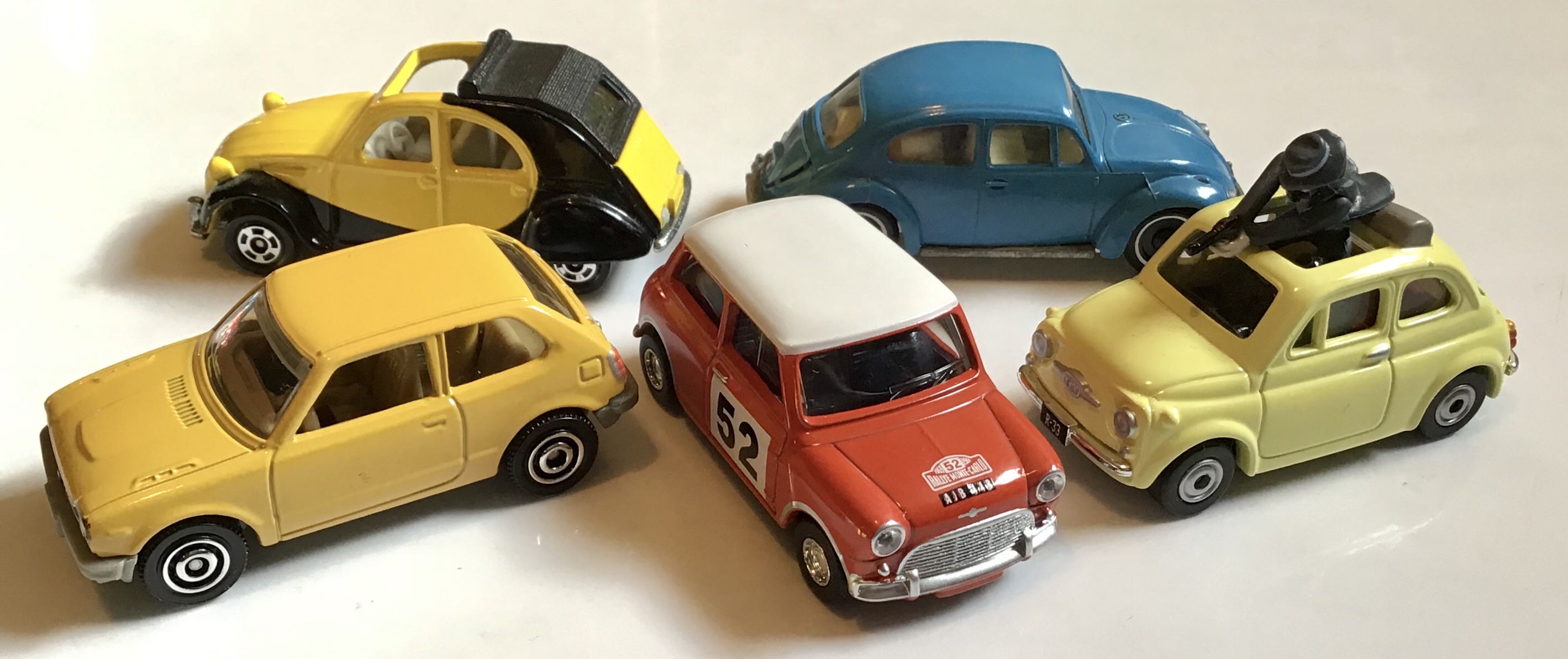
The focus here is on the small-scale examples of these five cars. The original VW Beetle, the Citroën 2CV, The Fiat Nuovo 500, the Austin Mini Cooper, and the Honda Civic CVCC are the five cars and each represents a unique response to the need for basic transportation, a people’s car. A review of the toy car versions will allow for a better understanding of the contribution the real cars made world-wide.

These five basic cars represent five decades of brilliant and successful ways to provide economical transportation for the masses.
Because there are so many small-scale examples of some of these cars, like the original Mini and VW Beetle, and so few of others like the Honda Civic and Fiat Nuovo 500, let’s proceed with the review by looking at which toy car makers have come closest to doing all five? Based on my collection, none have produced all five. Two have done four of the five and four more have done three of the five. I’ll start with those offering three of five and work up to those that have done four of five.


This story was prompted by Matchbox adding the first generation Honda Civic to their line in 2020. It joins the ’62 VW Beetle produced in 1999 and the Austin Mini Cooper done in 2009. Matchbox did earlier versions of the Racing Mini in 1971 and both the VW 1200 and 1500 Beetle even earlier, but I like the comparison of the more recent castings of these classic economy cars, especially in primary colors. All three are even available with the same heritage-style wheels. Is Matchbox on a ten-year cycle to add the Citroën 2CV and Fiat Nuovo 500? I hope not – I don’t want to wait until 2040! It would be great to see the other two added in a shorter time frame.

Like Matchbox, Siku offers a choice of VW Beetle models along with a Mini Cooper and Citroën 2CV. My collection includes three of the four VW Beetle examples but in this case I decided to use the 1200 from the 1960’s. This is a wonderful small-scale version of the Beetle and includes a rarity: the engine cover opens to view the famous air-cooled motor. The color is a perfect period blue. The white-walls were added by the previous owner, but are so perfect that I have left them in place. The 2CV is a more recent casting and comes with the fabric roof open or closed. The scale is 1:55 so it looks large compared to the Beetle. this is a 2CV6 from the end of the production run. The Mini Cooper is also in 1:55 scale or perhaps even a bit larger. Another more recent addition from Siku, it includes realistic wheels in the Minilite style. Siku did offer a Fiat 600 in their early plastic-bodied line but these models are very hard to find, so I do not yet have one.

Like Matchbox and Siku, there are three of the five feature cars offered as Corgi Juniors. The Mini is clearly a custom complete with a modified engine poking through the bonnet. This early 1970’s casting was in response to the custom cars from Hot Wheels that revolutionized the toy car market. The VW Beetle is a perfect example that came fresh from the package. Instead of the roof rack and luggage, some versions had a sticker to hide the fastening hole in the roof. The 2CV6 was added in this yellow to provide a new James Bond model. The scale must be over 1:55, but the casting is quite good and includes opening doors.

The last of the toy car makers to offer three models is Norev. All three are modern Norev castings rather than the earlier Mini Jets. The 2CV6 is in authentic Charleston colors and is an exceptional model. The wheels feature the correct hub caps and the paint quality is wonderful. The Mini Cooper represents the 1964 winner of the Rallye Monte Carlo. It is also an excellent casting with detailed graphics. The VW Beetle is easily identified as Herbie, the car made famous in “The Love Bug” movie. The paint and graphics are fine, but the front windshield seems to be the wrong shape. The color is more creamy when it should be white.

If the name Charawheels is not familiar, it is a brand name used in a joint venture between Bandai and Hot Wheels from 2002-2004. They produced a variety of vehicles and motorcycles from Japanese TV and anime. They are quite rare today and command high prices. The three-car set from Lupin the Third shown below is currently priced at $100. Two of the models from this set fit with the theme. An early Citroën 2CV and a Fiat Nuovo 500 were included. There is also a Humber Super Snipe (labeled as ‘Hambersupersnipe’)! All of these models are very well done and include characters. I bought them back in 2004 when the set was found for $15 at a local store featuring Japanese anime toys. Hot Wheels has also produced numerous VW Beetle models and I selected one of the more realistic to show. The Mini Cooper from Hot Wheels originally included a lift-off body. There are many collector and mainline variations. Hot Wheels has also done a recent racing version of the Nuovo 500.


Tomica and Hot Wheels both have offered four of the five cars discussed here. Will Hot Wheels offer a Honda Civic first gen before Tomica produces a Fiat Nuovo 500? My bet would be on Tomica, especially as Mattel’s other brand just did the Civic. The four models from Tomica have all been available for quite some time and can be found in a variety of colors. The Civic is the only one shown here with opening doors. The consistent quality and realism of models from Tomica are well illustrated by these four examples. It is easy to see why collectors are drawn to this brand. The color choices are wonderful and appropriate for each model. The Civic has had the lights detailed by a previous owner.
Other toy car makers have offered examples of these five cars, but I could not find any others in my collection that offered more than two. Perhaps your collection has something I have missed? It is also open to debate if an American sub-compact should be included with these five? Few, if any, American cars of this size could be consider as successful or significant as the five shown here. Many came from Europe like the Metropolitan, Ford Fiesta or Chevy Chevette. You might consider the Ford Model T to be the first people’s car, but it was not really a sub-compact. The Falcon/Corvair or Pinto/Vega models were hardly game changers like the five here. Your opinion on this is welcome.


Leave a Reply